AliyunEBS Image Storage Deployment Practice

About this task

ZStack Cloud seamlessly integrates the object storage service (OSS) provided by Alibaba Cloud, and loads it toZStack CloudPrivate Cloud as a new image storage type, AliyunEBS, which works with AliyunEBS primary storage and provides an image storage service.
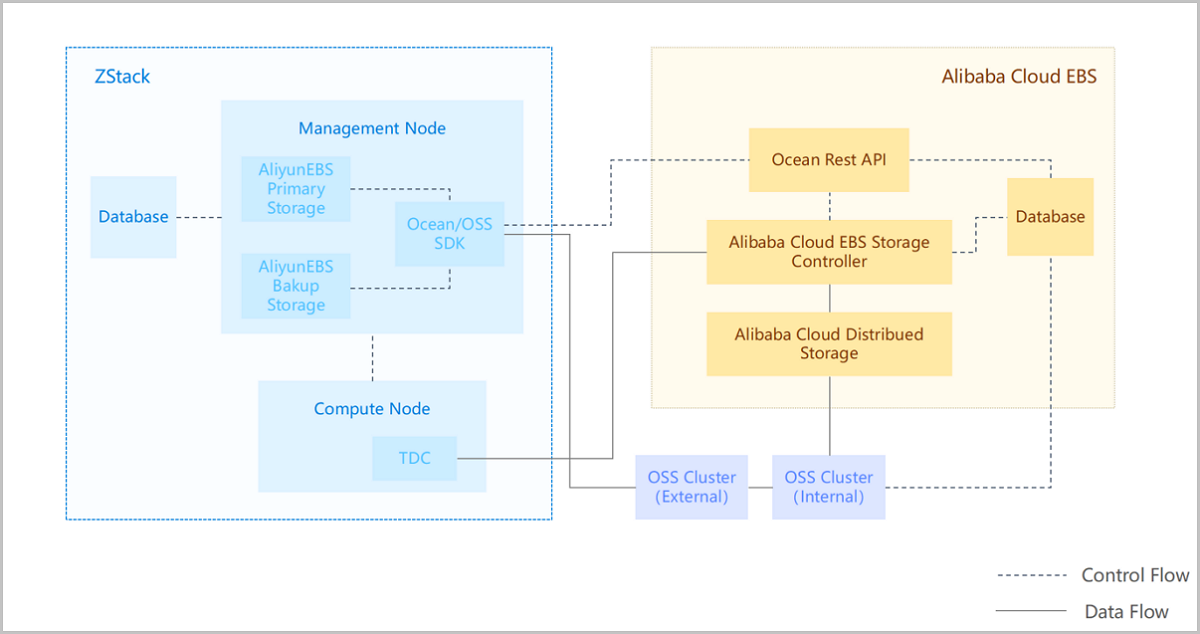
Figure 1. ZStack Seamlessly Integrates Alibaba Cloud EBS and OSS


To deploy an AliyunEBS image storage, follow these steps:
  1. If you add an AliyunEBS image storage for the first time, finish the following parameters in ZStack Cloud Hybrid Cloud Management.
    1. Add a Private Alibaba Cloud AccessKey. Set the AccessKey type as AliyunEBS.
    2. Add the Private Alibaba Cloud region where the EBS resides and the zones in the region.
    3. Add an OSS Bucket in the region.
  2. Add an AliyunEBS image storage on ZStack CloudPrivate Cloud.
  3. Manage the AliyunEBS image storage.

The deployment procedures are described in details as follows:

Procedure

  1. Finish configurations in ZStack Cloud Hybrid Cloud Management.
    1. Add a Private Alibaba Cloud AccessKey. Set the AccessKey type as AliyunEBS.

      On the main menu of ZStack Cloud Hybrid Cloud Management, choose Set > AccessKey Management. On the AccessKey Management page, click Add AccessKey. Then, the Add AccessKey page is displayed.
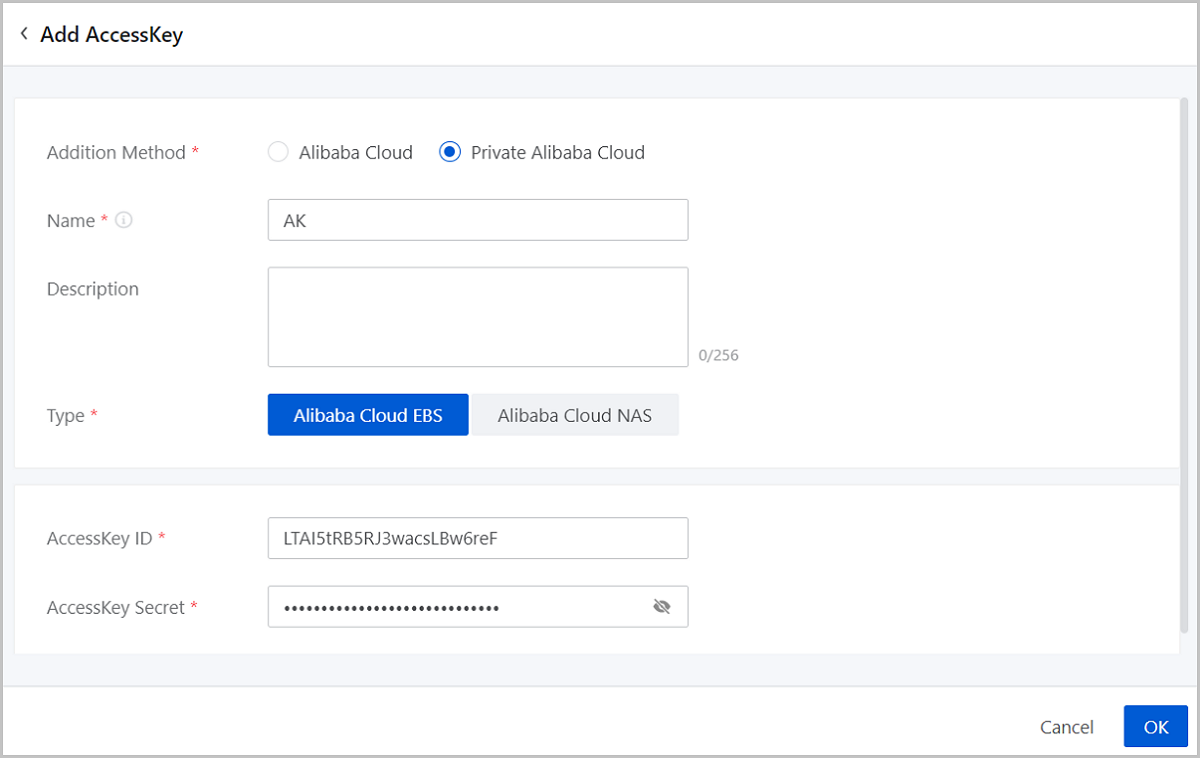
      On the displayed page, set the following parameters:
      • Addition Method: Choose Private Alibaba Cloud.
      • Name: Enter a name for the AccessKey.
      • Description: Optional. Enter a description for the AccessKey.
      • Type: Choose a Private Alibaba Cloud AccessKey type. Options: AliyunEBS and AliyunNAS.
      • AccessKey ID: Enter the AccessKey ID of a Private Alibaba Cloud account. Ensure the correctness of the AccessKey ID.
      • AccessKey Secret: Enter the AccessKey Secret corresponding to the AccessKey ID. Ensure the correctness of the AccessKey Secret.
      Figure 2. Add a Private Alibaba Cloud AccessKey


    2. Add the Private Alibaba Cloud region where the EBS resides and the zones in the region.
      1. Add the Private Alibaba Cloud region where the EBS resides.

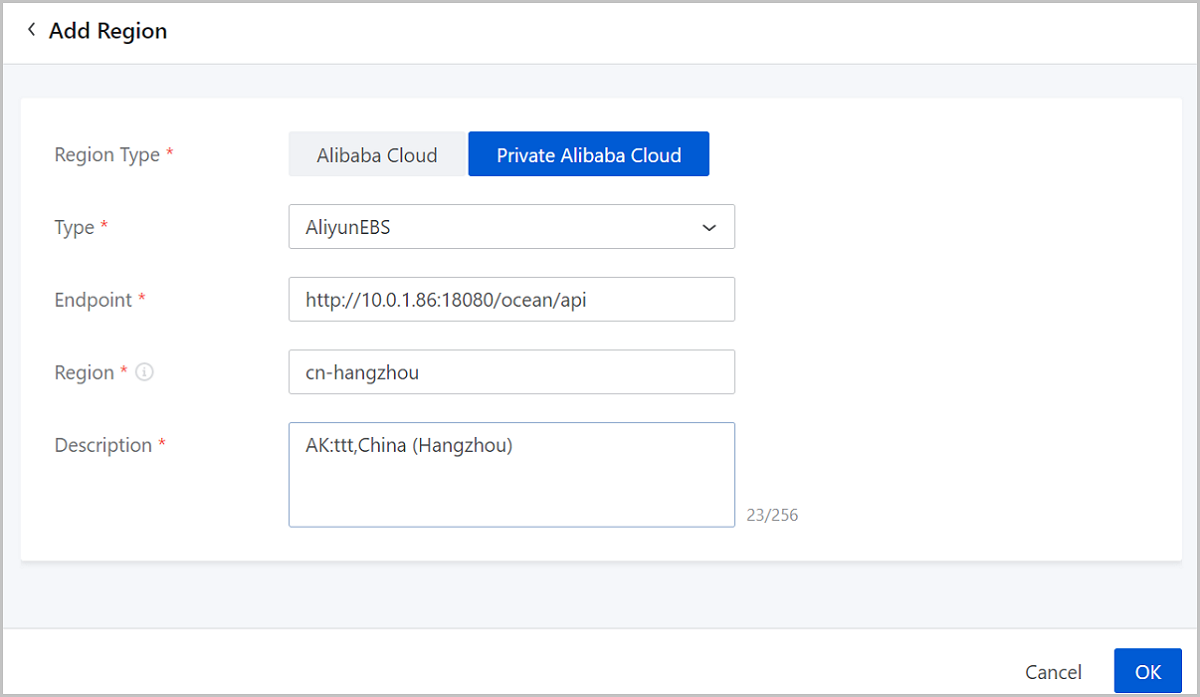
        On the main menu of ZStack Cloud Hybrid Cloud Management, choose Data Center > Region. On the Region page, click Add Region. Then, the Add Region page is displayed.

        On the displayed page, set the following parameters:
        • Region Type: Choose Private Alibaba Cloud.
        • Type: Choose AliyunEBS.
        • Endpoint: Enter the domain name of the Ocean external service.
          Note:
          • Ocean provides an external service with HTTP RESTful APIs.
          • Syntax: http://Ocean_Server_Domain:Port/ocean/api
          • Domain names varies according to regions.
        • Region: Enter a region can be accessed by the Private Alibaba Cloud AccessKey.
        • Description: Optional. Enter a description for the region.
        Figure 3. Add a Private Alibaba Cloud Region (Aliyun EBS)


      2. Add the zones in the region.

        The zones in the region are automatically synchronized after you add the region to local. If the zones are not synchronized automatically, you can manually add them through the following method.

        On the main menu of ZStack Cloud Hybrid Cloud Management, choose Data Center > Zone. On the Zone page, click Add Zone. Then, the Add Zone page is displayed.

        On displayed page, set the following parameters:
        • Region: Select a region can be accessed by the AccessKey.
        • Zone: Select an availability zone from the drop-down list.
        • Description: Enter a description for the zone. This is a required parameter.
    3. Add an OSS Bucket in the region.

      On the Region page, click the Private Alibaba Cloud region to enter its details page. On the details page, click Bucket > Add Bucket. Then, the Add Bucket dialog box is displayed.
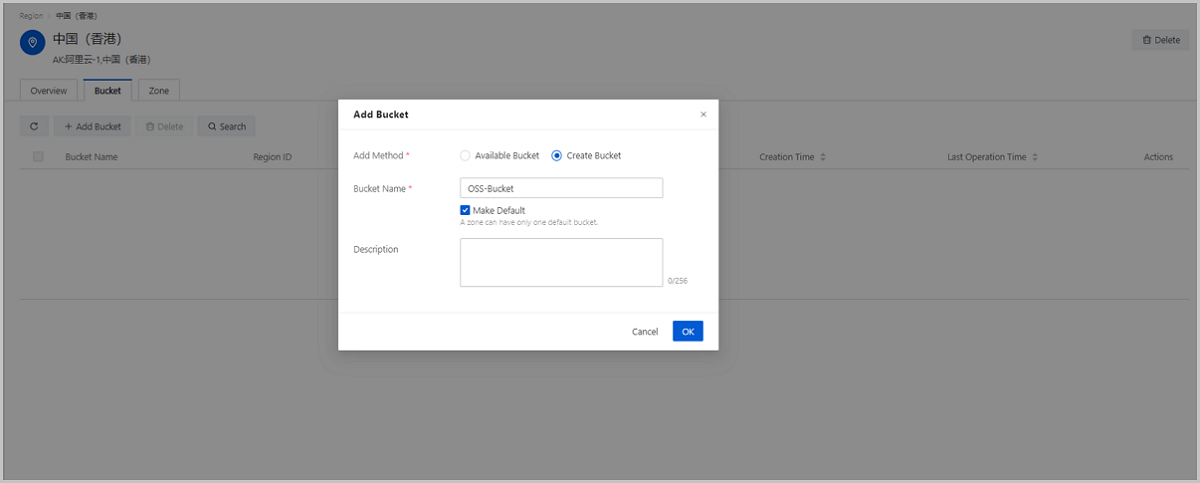
      On the displayed dialog box, set the following parameters:
      • Add Method: Choose Available Bucket or Create Bucket.
        If you choose Available Bucket, set these parameters:
        • Bucket: Select an available Bucket from the drop-down list.
        • Make Default: Set whether to make this Bucket the default Bucket in the region. You need to set one and only one default Bucket for a region. By default, the checkbox is selected.
        • Description: Optional. Enter a description for the Bucket.
        If you choose Create Bucket, set these parameters:
        • Bucket Name: Enter a name for the Bucket. The name cannot be used by other Buckets.
        • Make Default: Set whether to make the bucket the default Bucket in the region. You need to set one and only on default Bucket for a region. By default, the checkbox is selected.
        • Description: Optional. Enter a description for the Bucket.
      Figure 4. Add a Bucket


  2. Add an AliyunEBS image storage on ZStack CloudPrivate Cloud.
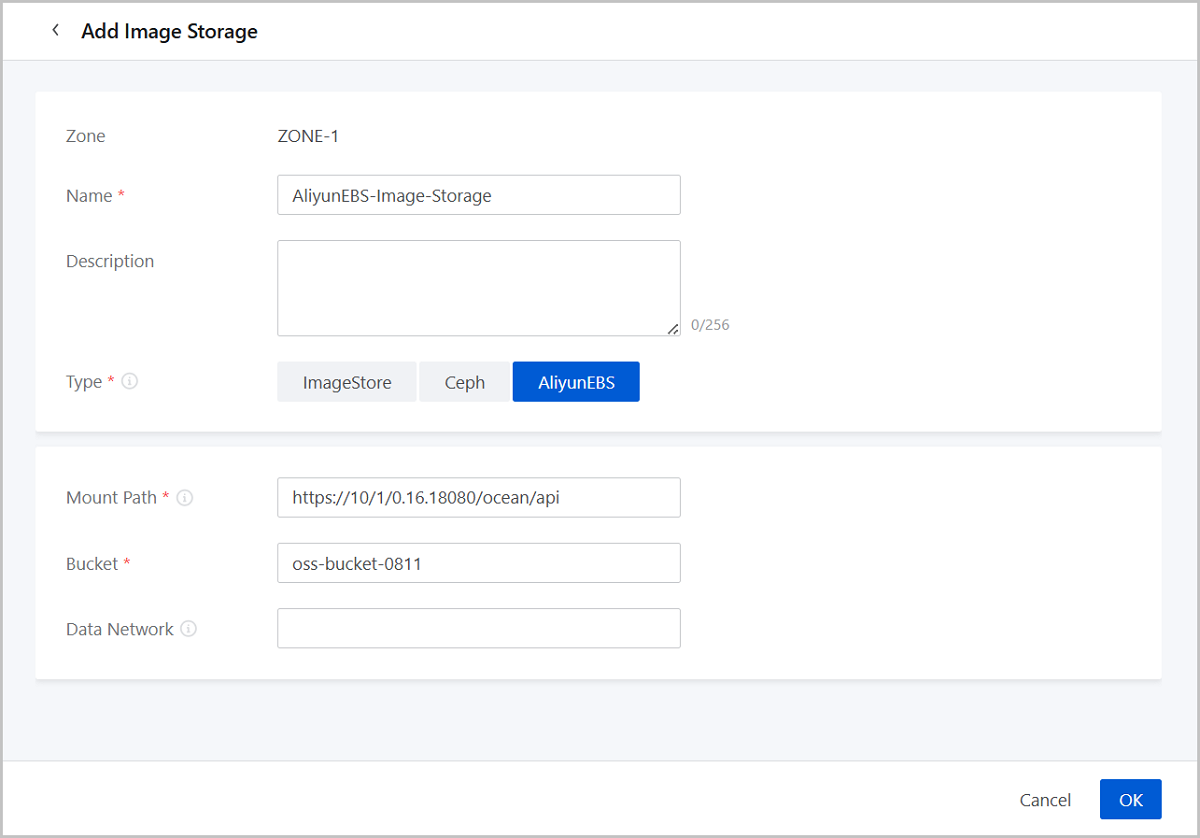
    On the main menu of ZStack Cloud, choose Resource Center > Hardware > Storage Facility > Image Storage. On the Image Storagepage, click Add Image Storage. Then, the Add Image Storage page is displayed.
    On the displayed page, set the following parameters:
    • Zone: The current zone is displayed.
    • Name: Enter a name for the image storage.
    • Description: Optional. Enter a description for the image storage.
    • Type: Choose AliyunEBS.
    • Mount Path: Enter an Ocean API endpoint.
      Note:
      • The AliyunEBS image storage uses the mount path to send requests to the Ocean Server.
      • Syntax: http://Ocean_Server_Domain:Port/ocean/api.
    • Bucket: Choose a Bucket added in ZStack Cloud Hybrid Cloud Management.
    • Data Network: The network used for the data communication between the compute node and the image storage. Setting an independent data network can avoid network congestion and improve transfer efficiencies. If not set, management networks will be used by default.
    Figure 5. Add an AliyunEBS Image Storage


  3. Manage the AliyunEBS image storage.

    On the Image Storage page, you can manage the AliyunEBS image storage, such as enabling, disabling, reconnecting, and deleting the image storage. You can centrally manage the images on the image storage and view the back storage visualized monitoring, alarm messages, and audit information.

What to do next

Now, you have deployed an AliyunEBS image storage successfully.

Archives

Download Document Archives

Download

Already filled the basic info?Click here.

Enter at least 2 characters.
Cannot be empty.
Invalid mobile number.
Enter at least 4 characters.
Invalid email address.
Wrong code. Try again. Send Code Resend Code (60s)

An email with a verification code will be sent to you. Make sure the address you provided is valid and correct.

同意 不同意

I have read and concur with the Site TermsPrivacy PolicyRules and Conventions on User Management of ZStack Cloud

Download

Not filled the basic info yet? Click here.

Invalid email address or mobile number.
同意 不同意

I have read and concur with the Site TermsPrivacy PolicyRules and Conventions on User Management of ZStack Cloud

Email Us

contact@zstack.io
ZStack Training and Certification
Enter at least 2 characters.
Invalid mobile number.
Enter at least 4 characters.
Invalid email address.
Wrong code. Try again. Send Code Resend Code (60s)

同意 不同意

I have read and concur with the Site TermsPrivacy PolicyRules and Conventions on User Management of ZStack Cloud

Email Us

contact@zstack.io
Request Trial
Enter at least 2 characters.
Invalid mobile number.
Enter at least 4 characters.
Invalid email address.
Wrong code. Try again. Send Code Resend Code (60s)

同意 不同意

I have read and concur with the Site TermsPrivacy PolicyRules and Conventions on User Management of ZStack Cloud

Email Us

contact@zstack.io

The download link is sent to your email address.

If you don't see it, check your spam folder, subscription folder, or AD folder. After receiving the email, click the URL to download the documentation.

The download link is sent to your email address.

If you don't see it, check your spam folder, subscription folder, or AD folder.
Or click on the URL below. (For Internet Explorer, right-click the URL and save it.)

Thank you for using ZStack products and services.

Submit successfully.

We'll connect soon.

Thank you for using ZStack products and services.